History
Rooted in prayer and service, our communities follow the vision of St. Norbert – bringing Christ’s light to every corner of the world.
Our History
The Premonstratensians (O. Praem): A Journey of Faith
In 1126, when the order received papal approbation by Pope Honorius II, there were nine houses; others were established in quick succession throughout Western Europe, so that at the middle of the fourteenth century there were some 1,300 monasteries for men and 400 for women. The Norbertines played a predominant part in bringing of Christianity to the territories around the Elbe and the Oder rivers.
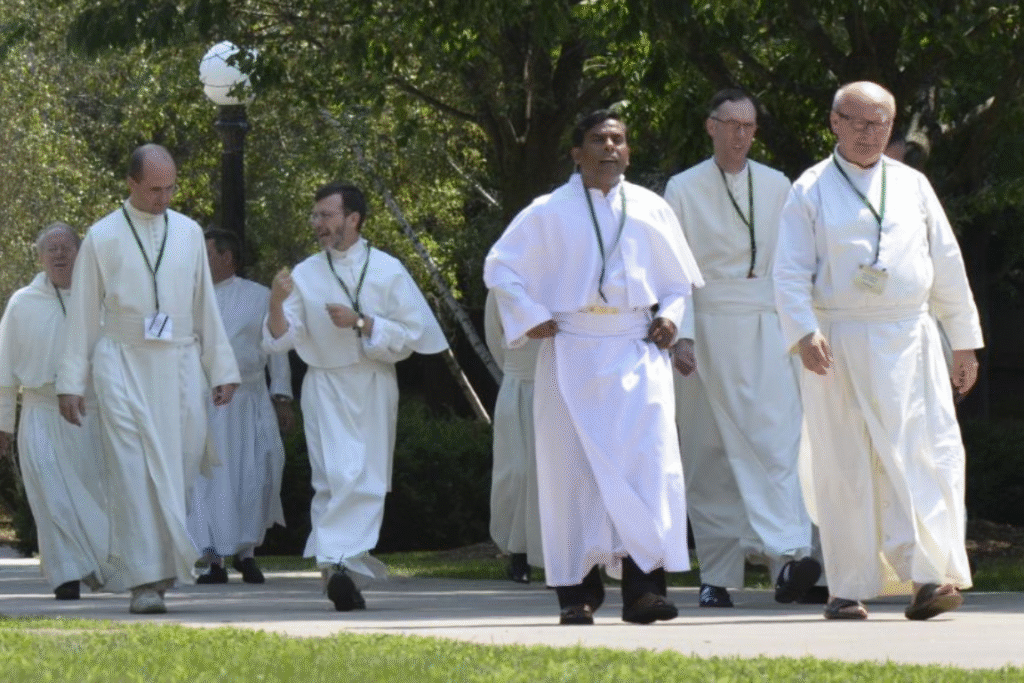
The “Norbertines”, also known as the Premonstratensians (O.Praem) and in Britain and Ireland as the White Canons (from the colour of their habit), are a Catholic religious order of canons regular founded at Prémontré near Laon in 1120 by Saint Norbert, who later became Archbishop of Magdeburg. Premonstratensians are designated by “O Praem” following their name Order of Premontre.
Life and Mission of the Canons Regular
Saint Norbert had made various efforts to introduce a strict form of canonical life in various communities of canons in Germany. In 1120 he was working in the now-extinct Diocese of Laon, in the Picardie region of northeastern France. There, in a rural place, called Prémontré, he and thirteen companions established a monastery to be the cradle of a new order. As they were canons regular, they followed the Rule of St. Augustine, but with supplementary statutes that made their life one of great austerity. As the Premonstratensians are not monks but canons regular, their work often involves preaching and the exercising of pastoral ministry; they frequently serve in parishes close to their abbeys or priories.
19th Century Decline
The Order was nearly extinct, with only 8 houses surviving in Austria.
20th Century Revival
A renaissance began, reaching 20 monasteries and 1,000 priests by the early 1900s.
Global Growth (2005)
Nearly 100 monasteries were established across every continent.
21st Century Today
About 1,000 male and 200 female members continue living under the Rule of St. Augustine.
The Structure
Autonomous Communities
Each abbey or priory is self-governing. Some embrace a contemplative life, while others are deeply engaged in pastoral ministry.
Unity in Diversity
The General Chapter brings together representatives from both male and female communities, showcasing Norbertine unity.
Rule & Constitutions
All communities follow the Rule of Saint Augustine and the Constitutions set by the General Chapter, convened every six years.
Abbot General
The Order is led by the Abbot General, based in Rome, assisted by Definitors (High Council) and commissions for liturgy, communication, and other needs.
Leadership
On 30th September 2003, Abbot Thomas Handgraetinger was elected the 64th Abbot General of the Norbertine Order.
Global Presence
As of 2008, Norbertine abbeys and priories exist worldwide across Australia, Europe, Africa, Asia, and the Americas, including countries like India, USA, UK, France, Germany, and South Africa.